How to Cut Cardboard Cleanly and Safely
Which tool to use on thin paperboard, corrugated board and chipboard, how to make straight cuts in several light passes, and the safer alternatives to an open blade.
Project at a glance
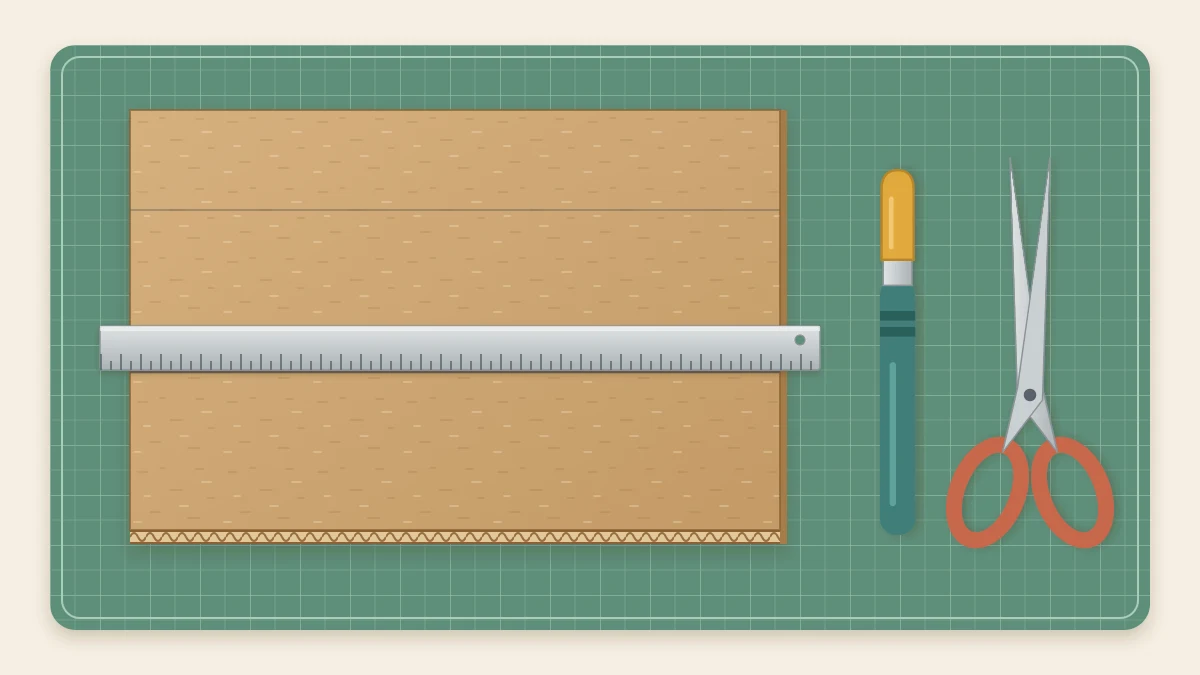
Materials
- Scrap cardboard for practice
- Metal ruler and pencil
- Self-healing cutting mat
- Scissors
- Craft knife with fresh blades (adult use)
- Safety cutter with a shielded blade (optional)
Most rough edges in a cardboard project come from the cut, not from the material. Learning how to cut cardboard well is mostly a matter of matching the tool to the board, keeping the blade sharp and letting several gentle strokes do the work that one hard push cannot.
This guide covers the basic, low-risk methods: scissors for thin board and curves, and a craft knife with a metal ruler and a cutting mat for straight lines in corrugated cardboard. Knife work is a job for an adult. If you would rather not use an open blade at all, there are good alternatives further down.
Match the tool to the board
Thickness decides the tool. Forcing scissors through thick board crushes the flutes, and a knife is more than thin board needs.
| Board | Best tool | Good to know |
|---|---|---|
| Thin paperboard (cereal-box weight) | Scissors | Handles straight lines and curves easily |
| Single-wall corrugated, about 1/8 in (3 mm) | Craft knife and metal ruler, or a safety cutter | Sturdy scissors manage short cuts |
| Double-wall corrugated, about 1/4 in (6 mm) | Craft knife and metal ruler | Expect four or five light passes |
| Chipboard | Craft knife and metal ruler | Dense, so go slowly and stay patient |
If you are still putting a kit together, the starter list of cardboard craft tools explains what is worth having and what can wait.
Set up a safe cutting surface
Good cuts start before the blade touches the board. Take two minutes to prepare the space.
- Work at a flat, steady table with good light, standing or sitting squarely in front of the line.
- Lay down a self-healing cutting mat larger than the cut you plan to make. It protects the table and keeps the blade from skidding.
- Support the whole sheet on the table so the piece does not drop or twist as it comes free.
- Draw the line in pencil first. Cutting by eye is how lines wander.
Cut straight lines in several light passes
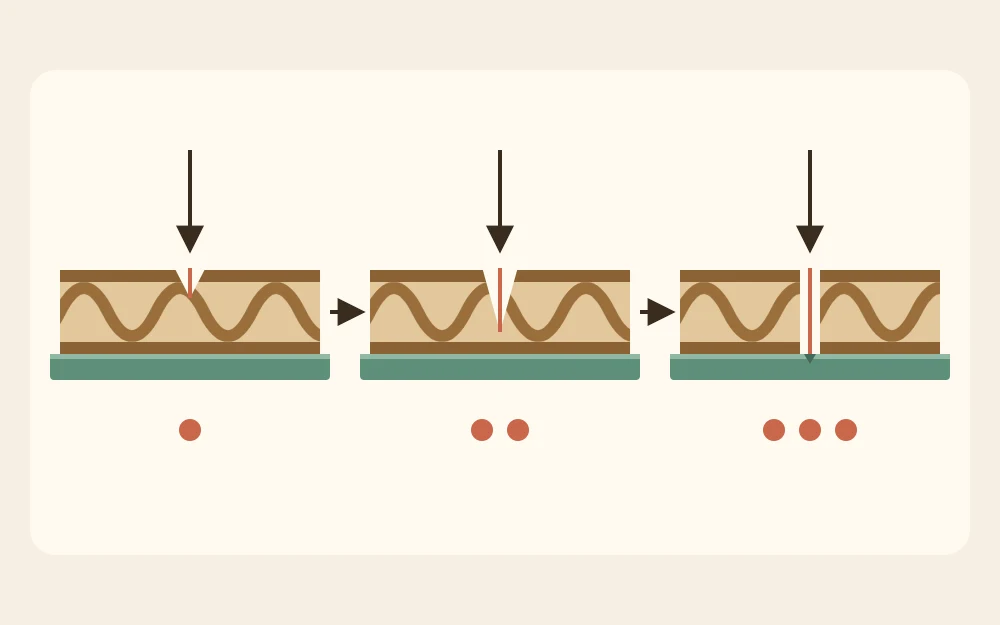
The most useful habit in knife work is to stop trying to cut through in one stroke. Light passes are easier to control and leave a cleaner edge.
- Fit a fresh, sharp blade. A dull blade needs more force, and force is what makes a blade slip.
- Lay a metal ruler along the line, covering the part you want to keep. If the blade drifts, it drifts into the waste.
- Press the ruler down with a flat hand, fingertips well back from its edge and behind the cutting path, never ahead of the blade.
- Hold the knife like a pencil at a low angle and draw it along the ruler, away from your body, with light pressure. The first pass only needs to slice the top liner.
- Repeat in the same groove. The second pass goes through the flutes and the third through the bottom liner. Thicker board needs more passes.
- Lift the ruler only when the piece is free. Cap or retract the blade before you put the knife down.
Safety note
Craft knives are for adults only. Keep the hand that holds the ruler behind the blade, cut away from your body, and reposition the board instead of twisting your wrist into an awkward angle. Change the blade as soon as it starts to drag, and cap or retract it every time it leaves your hand.
Cut thin board and gentle curves with scissors
Scissors are the simplest and safest choice for thin paperboard, and many small projects can be made entirely with scissors and thin board. A few details improve the result:
- Use the full length of the blades in long, smooth closes instead of short snips, which leave a stepped edge.
- Stop each close just before the tips meet, then slide forward and continue.
- For curves, turn the board into the scissors and keep the cutting hand almost still.
- Cut slightly outside the pencil line, then trim back to it on a second pass.
Alternatives to an open blade
A safety cutter has a shielded blade that sits inside a plastic guard, with only a small cutting edge exposed in a slot. You hook it over the edge of the board and pull it along the line. It handles single-wall corrugated well on straight cuts that start at an edge, although it cannot begin in the middle of a panel.
Scoring and then snapping is another option for straight cuts in corrugated board. Press a deep groove along the line with a blunt tool and a ruler, fold the board back and forth along that groove until the inner layers give, then cut the last liner with scissors. The edge is a little rougher than a knife cut, so save it for parts that will be hidden or covered. The groove itself is made exactly as described in the guide to scoring and folding cardboard.
Cut with or across the flutes
Corrugated board behaves differently in each direction. Cutting along the flutes is easy, but the blade tends to drop into a channel and follow it, so if your line sits at a slight angle to the flutes the cut can drift. Keep the blade against the ruler and use very light first passes.
Cutting across the flutes takes more passes because the blade meets every ridge, but the line stays where you put it.
Curves and inside windows
For a curve in corrugated board, scissors usually do a better job than a knife. Cut the shape roughly first, about 1/4 in (6 mm) outside the line, so the waste falls away, then follow the line itself with a second cut.
A window is four straight cuts that stop at the corners. Begin each one exactly at a corner and end it exactly at the next, using the ruler and light passes as before, and turn the board between cuts so you are always pulling the blade away from yourself. Do not push the waste out until all four cuts are through, or the corners will tear.
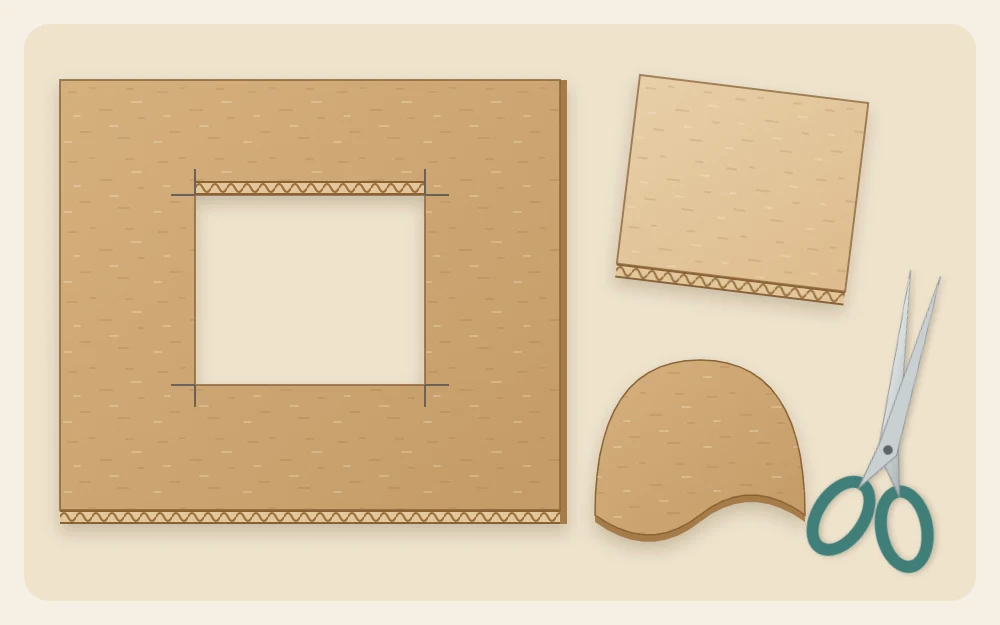
If you prefer to avoid knife work, build the window as a frame from four separate strips instead.
Tidy up a ragged cut
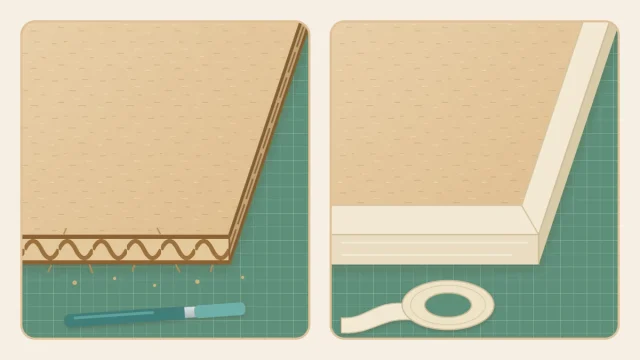
Small faults are easy to correct. Trim a fuzzy edge with one more light pass along the ruler, or snip stray fibers with scissors. Where the wavy core will show on a finished piece, the guide to hiding the corrugated edge compares the ways to cover it.
Frequently asked questions
Can I cut corrugated cardboard with scissors?
Yes, for short cuts and curves in single-wall board, as long as the scissors are sturdy and sharp. Long straight cuts tend to come out slightly wavy and the edge gets squeezed, so for those a safety cutter pulled along a line, or an adult using a knife and metal ruler, gives a neater result.
Why does my cardboard tear instead of cutting cleanly?
Tearing nearly always points to a dull blade or too much pressure. A worn edge drags the paper fibers instead of slicing them. Fit a new blade, lighten your grip and make more passes in the same groove. Damp or very soft board also tears, so store sheets somewhere dry.
How many passes does it take to cut through cardboard?
For single-wall corrugated board, plan on roughly three: one for the top liner, one for the wavy core and one for the bottom liner. Double-wall board and chipboard often need four or five. Counting passes matters less than keeping each one light and in the same groove.