How to Glue Cardboard: Adhesives and Strong Joints
A comparison of white glue, tacky glue, glue stick, low-temperature hot glue and tapes, plus four joint types and the thin-coat, clamp-and-wait routine that keeps them together.
Joints that pop apart are rarely the fault of weak glue. Far more often the glue was too thick, the surfaces were too small, or the parts were let go before the bond had set. Knowing how to glue cardboard is therefore two skills: picking an adhesive that suits the job, and shaping the joint so the glue has enough area to hold.
Cardboard is absorbent paper, which makes it one of the easiest materials to bond. Ordinary white glue soaks into both surfaces and locks the fibers together. The other adhesives below are useful for particular situations, not replacements for it.
Adhesives compared
Grab time is how long you have to hold the parts before they stay put by themselves. The figures are approximate and change with room temperature, humidity and how much glue you use.
| Adhesive | Grab time | Strength | Best use |
|---|---|---|---|
| White (PVA) glue | A few minutes with clips | High once dry | Structural joints, laminating layers |
| Tacky glue | About a minute | High once dry | Small parts, glue tabs, vertical joints |
| Glue stick | Almost instant | Low | Covering paper only |
| Low-temperature hot glue | Seconds | Medium | Quick tacking by an adult |
| Double-sided tape | Instant | Low to medium | Flat, light decoration |
| Paper tape | Instant | Medium | Hinges, corner reinforcement |
White glue is the default
White glue, known chemically as polyvinyl acetate, is inexpensive, cleans up with water and dries clear. It gives you time to adjust the parts, which matters when you are lining up a corner. A joint is usually firm enough to handle in roughly 20 to 30 minutes and reaches full strength after several hours or overnight.
Tacky glue is a thicker version of the same idea. It holds sooner and slides less, so it is helpful on small tabs and upright parts that would otherwise creep while they dry. A glue stick has too little strength for structure, but it lays paper down flat with almost no moisture, which is exactly what a covering needs.
Safety note
Low-temperature hot glue is an option for adults who want an instant hold, for example to tack a part in place while white glue dries. The nozzle and the glue can still burn skin, so keep fingers clear, rest the gun on its stand and unplug it when you finish.
Joints that hold
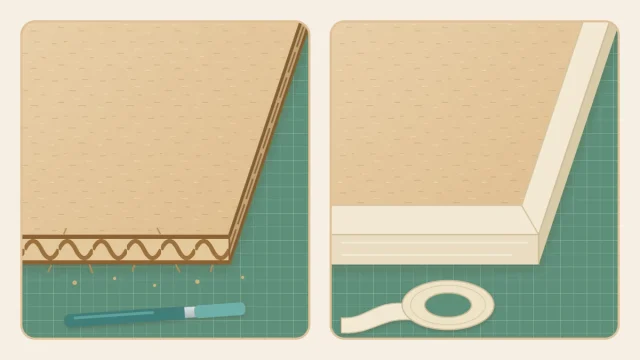
Glue needs surface area. The raw edge of a corrugated sheet is mostly air, so two edges touching have very little to bond with. Each of the joints below solves that problem in a different way.
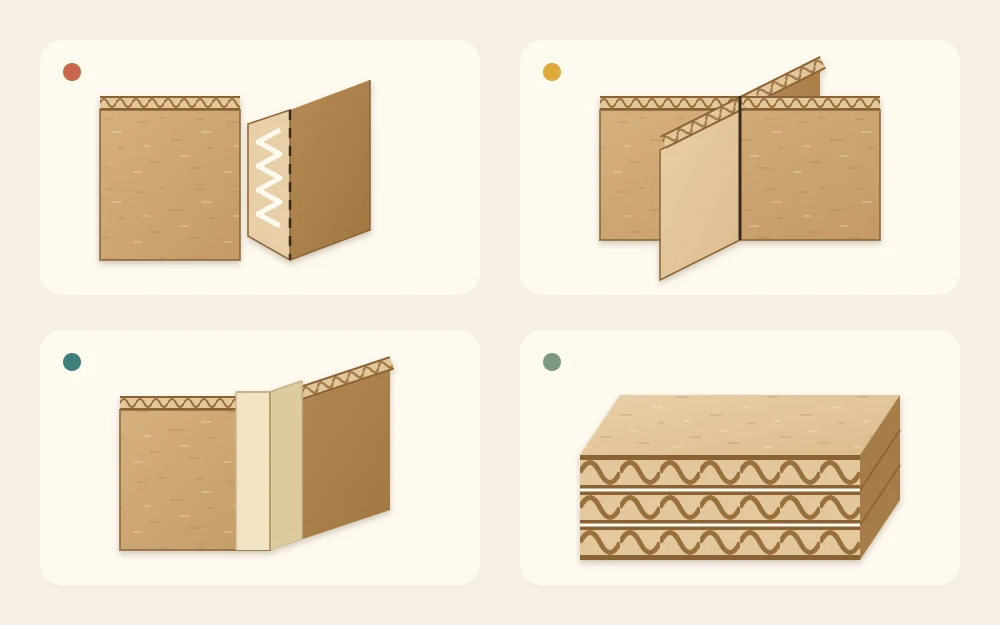
Glue tabs
A glue tab is a flap left on one part that folds over and bonds flat against its neighbor. Make tabs about 1/2 to 3/4 in (12 to 20 mm) wide, and trim their ends at an angle so they do not collide in a corner. Tabs fold accurately only when the line has been pressed first, as covered in the guide to scoring and folding cardboard.
Butt joint with a paper tape hinge
Where two panels meet edge to face, run a thin line of white glue along the edge, press the panels together, then lay a strip of paper tape along the outside of the corner. The tape acts as a clamp while the glue dries and stays on as reinforcement. A second strip inside the corner makes it stiffer still.
Slot joints
Two panels with matching slots cut halfway across each one slide together into a cross. Make each slot as wide as the board is thick, about 1/8 in (3 mm) for single-wall corrugated. A snug slot joint holds without glue, and a drop in each slot makes it permanent.
Laminated layers
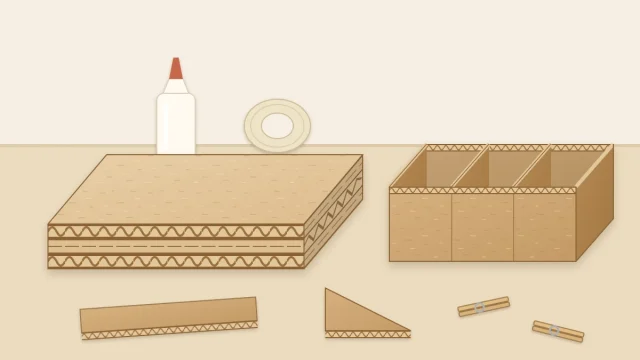
Gluing whole faces together gives the largest bonding area of all and turns thin sheets into a thick, rigid one. This is as much a way of adding stiffness as a joint, and the guide to strengthening cardboard explains how to arrange the layers.
Apply a thin, even coat
More glue does not make a stronger joint. A thick bead takes far longer to dry, squeezes out along the seam and adds enough water to warp the board.
- Dry fit the parts first so you know they meet before any glue is involved.
- Put a small amount of glue on one surface and spread it into a thin film with a stiff brush, a scrap of card or a fingertip. You should still see the board through it.
- Wait about half a minute until the film turns slightly tacky, then bring the parts together.
- Press firmly along the whole joint and wipe away any squeeze-out with a barely damp cloth.
Clamp and let it dry
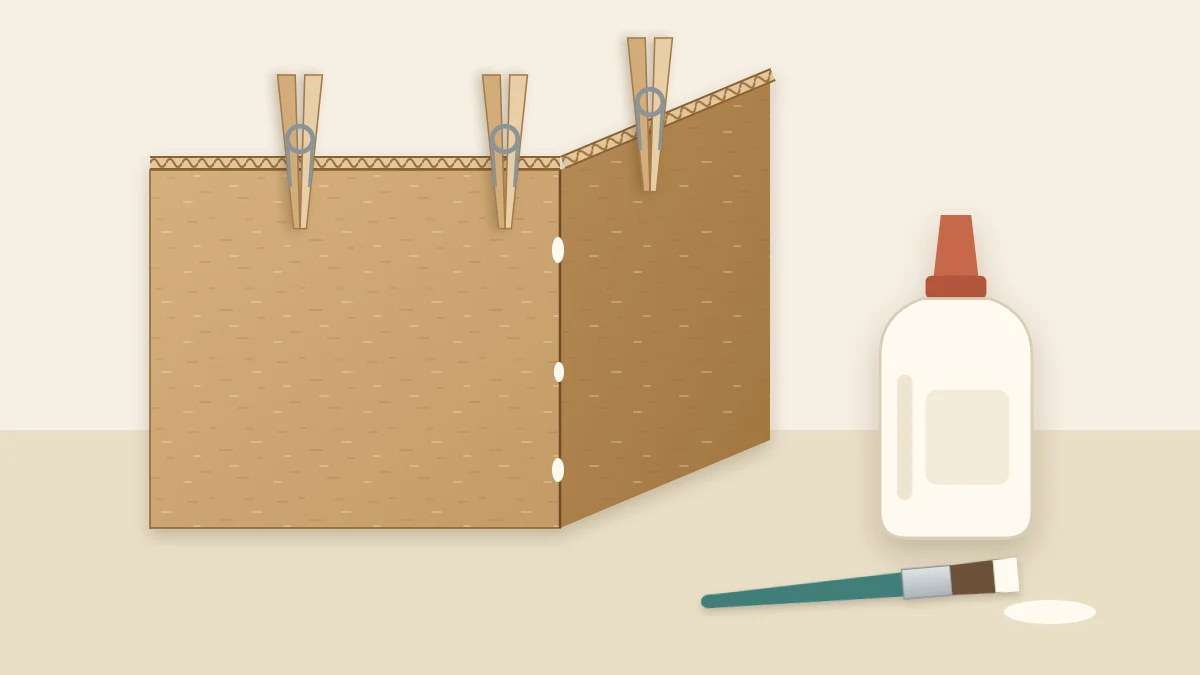
Even pressure while the glue sets matters as much as the glue. Clothespins and binder clips hold tabs and rims. Masking tape wrapped around a box pulls its corners in. For flat laminated panels, lay the work on a table under a sheet of scrap paper and a few heavy books.
Slip a scrap of card under each clip so its jaws do not leave dents in the liner. Then leave the piece alone. Most failed joints were tested too early, while the glue was still soft in the middle. The cardboard craft tools starter kit lists the clips and brushes that are worth keeping within reach.
Why joints fail
- Glossy or coated surfaces. Printed packaging often has a slick finish that glue cannot soak into. Roughen it lightly with fine sandpaper over scrap paper, or peel the coated layer off the tab.
- Edge-only contact. Add a tab, a tape hinge or a small corner block to give the glue a face to hold.
- Dust and loose fibers. Brush off cut edges before gluing.
- Too much glue. A wet, thick layer stays soft and lets parts slide. Spread it thinner.
- No pressure. Parts that only rest against each other bond in a few spots. Clip or weight them.
- Stress in the joint. If a part has to be forced into position, it will keep pulling. Trim or re-score it until it sits in place by itself.
Frequently asked questions
What is the best glue for cardboard?
For most projects, plain white (PVA) glue. It soaks into the paper fibers, dries clear and gives a joint that is often stronger than the board around it. Tacky glue is a good second choice when parts need to hold sooner. Glue sticks are best kept for attaching covering paper.
How long should I hold or clamp a glued cardboard joint?
With white glue, keep clips or weights on for roughly 20 to 30 minutes, until the joint is firm enough to handle gently. Full strength takes several hours, so leave anything that will be handled a lot overnight. Thick layers of glue and humid rooms slow everything down.
Why does glue make my cardboard warp?
White glue contains water, and the paper swells where it gets wet. A thick layer on one face makes that side expand and the panel curls. Spread the glue thinner, work quickly, and dry flat pieces under a weight so they stay level while the moisture leaves.