Types of Cardboard for Crafts: Corrugated, Chipboard and More
Single-wall, double-wall, chipboard, thin paperboard and tubes explained: how to tell them apart, why flute direction matters, and which board to choose for each kind of project.
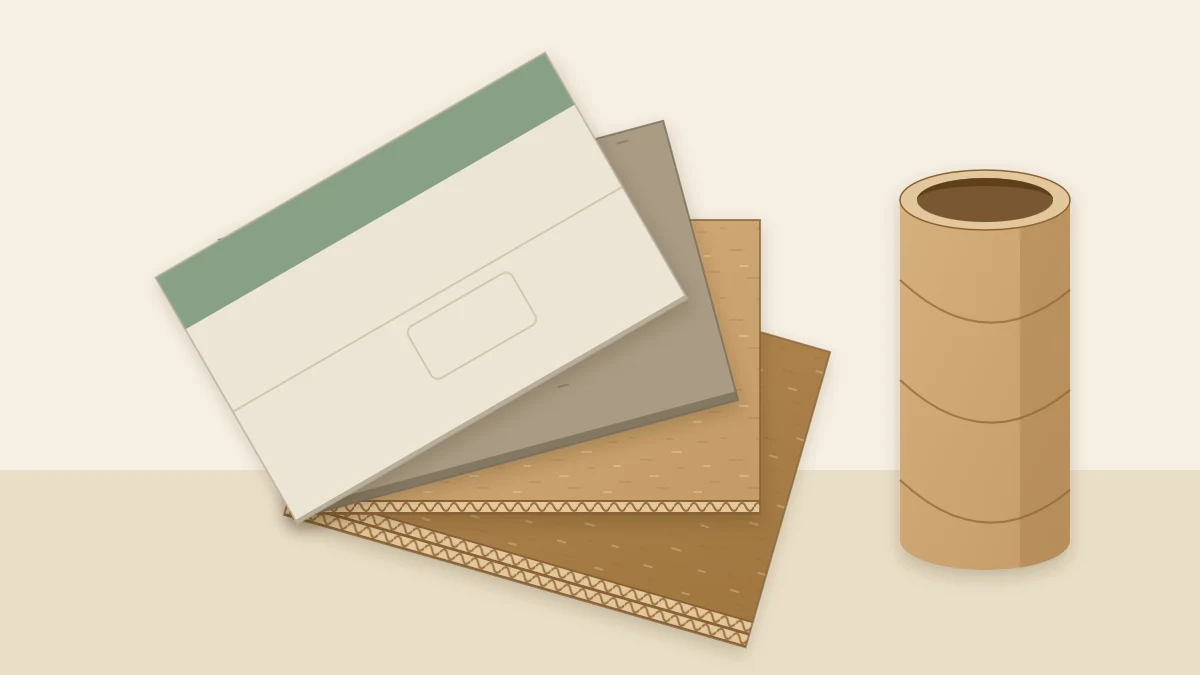
A pile of saved boxes looks like one material, but it rarely is. A shipping carton, a cereal-style box, the back of a notepad and a paper towel tube all behave differently when you cut, fold and glue them.
Knowing the main types of cardboard for crafts lets you match the board to the job before you start measuring. The sections below cover what each kind is, how thick it tends to be, what it does well, and which boxes are better left in the recycling.
How corrugated cardboard is built
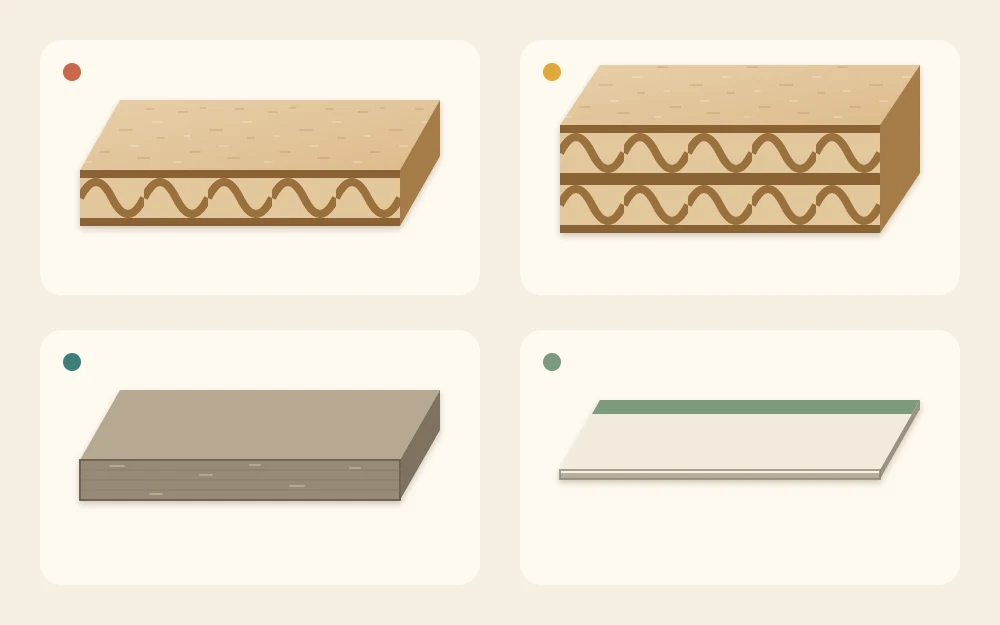
Corrugated cardboard is a sandwich. Two flat sheets of paper, called liners, are glued to a wavy inner layer called the flutes. The air trapped in those waves is what makes the board light yet stiff. If you are curious about the manufacturing side, there is a clear overview of how corrugated fiberboard is made.
Look at a cut edge and you can see the structure straight away. One row of waves means single-wall board. Two rows stacked with a liner between them means double-wall.
Flute direction: the grain of the board
The flutes run in one direction across a corrugated sheet, like the grain in a plank of wood. This flute direction changes how the board behaves more than anything else.
- Folding along the flutes (parallel to the tunnels) is easy and gives a neat line, because the board bends in the valley between two waves.
- Folding across the flutes takes more effort and needs a firm score first, or the fold will wander and crack.
- Stiffness is greatest along the length of the flutes. A box wall with vertical flutes resists crushing from above far better than one with horizontal flutes.
To find the grain, look at the edge for the open tunnels, or flex the sheet gently both ways. It gives more readily one way than the other. Thin paperboard and chipboard have a slight grain too, though it matters less.
Once you know which way the flutes run, plan the folds around them. The guide to measuring, scoring and folding accurately shows how to handle folds in both directions.
Single-wall corrugated cardboard
This is the everyday shipping box, roughly 1/8 in (3 mm) thick. It is the most useful board for a beginner: easy to find, stiff enough for walls, and light enough to cut with hand tools.
Use it for boxes, trays, desk organizers, drawer dividers, magazine holders and wall decor.
Its weakness is the edge. Exposed flutes look rough and crush easily under scissors, so cut edges usually need covering or binding on a finished piece.
Double-wall corrugated cardboard
Double-wall board has two layers of flutes and is roughly 1/4 in (6 mm) thick. It comes from cartons made for appliances, furniture and other heavy goods.
It makes rigid bases, shelves for light items and backing boards for wall art. It is hard to fold neatly and too thick for household scissors. Cutting it calls for a craft knife, which is a job for an adult working on a cutting mat with a metal ruler and several light passes. A safety cutter with a shielded blade is a sensible alternative for long straight cuts.
If you cannot find double-wall, you can make an equivalent by gluing two single-wall sheets together. The article on ways to make cardboard stiffer explains why crossing the flutes at right angles works so well.
Chipboard
Chipboard is dense, solid board with no flutes at all. It is gray or brown all the way through and commonly about 1/16 in (1.5 mm) thick. You will find it as the backing of notepads and writing tablets, inside hardcover binders, and as stiffeners in packaged shirts and envelopes.
Because the edge is solid, it stays clean and takes paint well. That makes chipboard the natural choice for rigid gift boxes, lids, book-style covers, frame fronts and miniature parts. It does not fold; you join separate panels with tape or glue instead.
Thin paperboard
Thin paperboard is cereal-box weight: a single layer about 1/64 in (0.5 mm) thick, printed on one side and plain gray or brown on the other. Cracker, tissue and tea boxes are all made from it.
It cuts easily with scissors, scores and folds crisply, and curves without creasing. Use it for bookmarks, gift tags, woven strips, small nets and mini models. On its own it is too flimsy for anything that has to stand up to handling, but two or three layers glued together become a surprisingly firm sheet.
Work on the plain side and cover or paint the printed side if it will show.
Cardboard tubes
Tubes from paper towels and wrapping paper are spiral-wound paperboard. Thin ones cut with scissors if you flatten them slightly first, and they are handy for pencil cups, napkin rings and round columns in models.
Which cardboard suits which project
| Type | Typical thickness | Cuts with | Best for |
|---|---|---|---|
| Single-wall corrugated | About 1/8 in (3 mm) | Safety cutter or knife; scissors for short cuts | Boxes, trays, organizers, dividers |
| Double-wall corrugated | About 1/4 in (6 mm) | Safety cutter or knife | Bases, backing boards, sturdy panels |
| Chipboard | About 1/16 in (1.5 mm) | Heavy scissors, or knife | Rigid gift boxes, lids, frames |
| Thin paperboard | About 1/64 in (0.5 mm) | Scissors | Bookmarks, tags, weaving, mini models |
| Tubes | Varies | Scissors for thin tubes | Pencil cups, napkin rings, columns |
Whatever you build, cardboard is a material for light, dry household items. Choosing a thicker board makes a piece stiffer, but it does not turn it into furniture.
Where to find it, and which boxes to skip
Home deliveries cover most needs. Flatten what you collect and store it flat in a dry place, sorted by type.
Leave these in the recycling:
- Greasy or food-stained boxes. Oil stops glue and paint from gripping and can smell over time.
- Damp or once-wet board. It warps, the layers separate, and it may be musty.
- Heavily taped or labeled boxes. Peeling tape tears the liner and leaves a patchy surface.
- Crushed or creased panels. A dent in the flutes becomes a weak line in your project.
- Waxed or glossy coated board. White glue and water-based paint struggle to bond to it.
Tip
Draw a small arrow in pencil on each stored sheet to show the flute direction. It saves checking the edge every time you plan a fold.
If you are still gathering supplies and wondering what to make first, the beginner’s starting guide sets out a simple order of projects.
Frequently asked questions
What is the difference between cardboard and chipboard?
In everyday use, cardboard usually means corrugated board, which has a wavy fluted layer between two flat liners. Chipboard is solid, dense board with no flutes. Corrugated board is thicker, lighter and folds along its flutes, while chipboard is thinner, stays flat and has a clean solid edge.
How do I tell which way the flutes run?
Look at the cut edges of the sheet. On two opposite edges you will see open tunnels, and the flutes run between those two edges. You can also flex the sheet gently in both directions: it bends more easily along the flutes than across them.
Is cereal box cardboard strong enough for boxes?
A single layer of thin paperboard is fine for small, light boxes that will not be handled much. For anything larger, glue two or three layers together with thin coats of white glue and press them flat while they dry, or switch to single-wall corrugated cardboard for the walls and base.